
Maintenance
Deck Cleaning vs. Restaining: Which Does Your Deck Need?
By Ivan ·
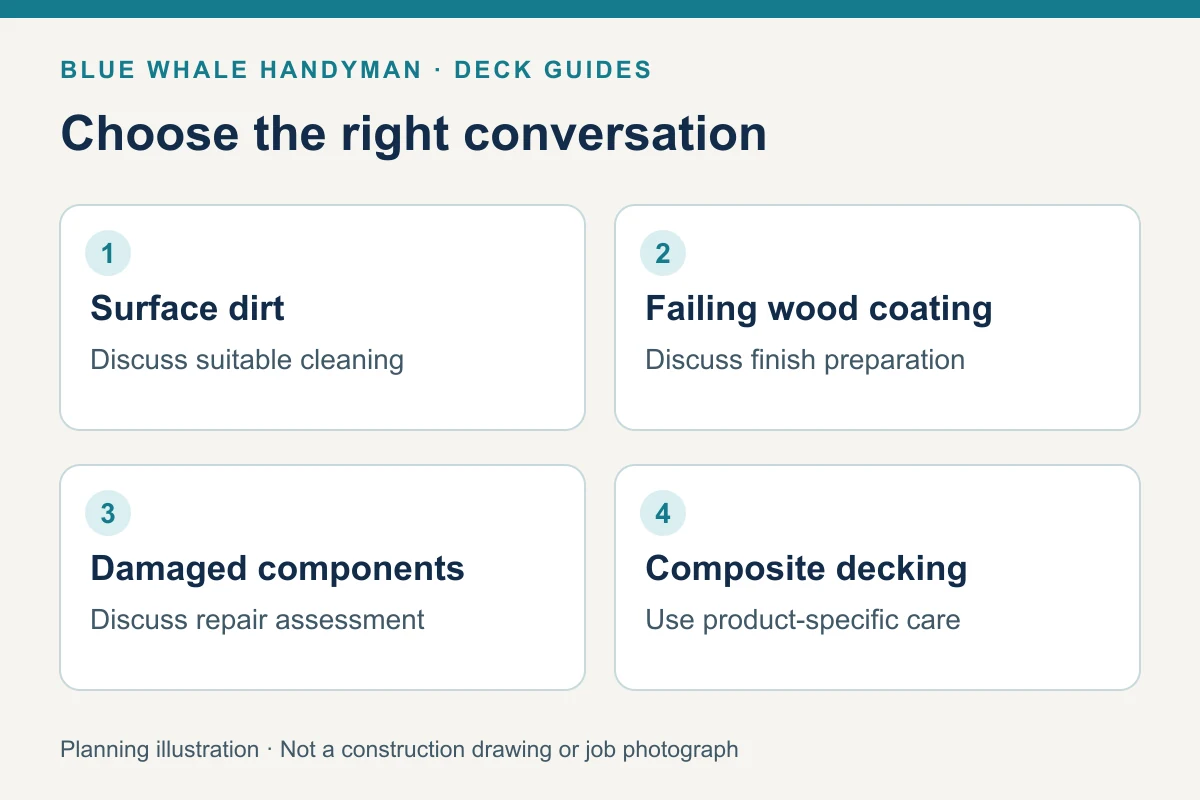
A dirty deck does not necessarily need a new coating, and a peeling finish needs more than cleaning alone. Start by identifying the material and separating surface dirt, coating deterioration and physical damage.
The useful question is what result each operation can reasonably deliver. Cleaning may improve the appearance of a suitable surface. A coating project addresses a different goal and needs its own preparation and application plan. Neither one establishes the condition of the deck’s supports or connections.
Compare the three conversations
A deck can need more than one of these. Ask for the scope to separate them so you understand which work is included and what will remain unchanged in appearance or condition.
| Concern | Discussion to start | What to clarify |
|---|---|---|
| Dirt or debris on an otherwise suitable surface | Product-appropriate cleaning | Material, method, included areas and protection |
| Worn or lifting wood coating | Finish and preparation assessment | Old product, removal needs, new system and drying conditions |
| Damaged boards or unstable components | Repair assessment | Cause, extent, supporting components and access |
Identify wood and composite before choosing a method
Trex publishes different care guidance for its decking products. A method suitable for one product generation should not be assumed suitable for another.
For composite, identify the manufacturer and collection where possible. Do not treat it like a wood deck that can automatically be sanded and stained. For wood, the existing finish and condition help determine suitable preparation. Ask the contractor to explain the method proposed for the actual material.
Restaining includes more than choosing a color
A wood coating proposal should identify cleaning or removal work, any repairs that come first, the included faces and edges, and the new product. Application and return-to-use conditions should follow that product’s instructions.
If the old coating is lifting, read why deck stain peels before accepting a simple recoat proposal.
A deck does not necessarily need the same work on every face. Ask whether railings, stair parts and the main surface have been assessed separately and how the finished appearance will be handled across them.
A documented restoration example
Our deck and patio restoration project records work described in a customer review: power washing the deck and patio, cementing pool railing anchors and replacing sand between stones.
Those are three distinct tasks. The review does not establish that the deck was stripped, stained or rebuilt, so those operations should not be assumed part of that example. It illustrates why a short written task list is more useful than the broad label “restoration.”
Request the surface work your deck actually needs
For an appropriate cleaning scope, see our pressure washing service.
If damaged components or a broader restoration need assessment, use our deck repair service.
Send the material name if known, wide photos, closer views of the concern and the outcome you want. Ask which preparation, protection and cleanup are included, and how the area will remain out of use while the work requires it.
Common questions
Will washing make weathered wood look new?
Cleaning can change the appearance, but it cannot reverse every effect of weathering or remove every stain. Ask for realistic expectations based on the surface and a suitable trial area where appropriate.
Does composite decking need maintenance?
Yes. Composite decking still needs care and cleaning. Use the guidance for its specific manufacturer, collection and generation rather than assuming it is maintenance-free.
Is pressure washing suitable for every deck?
No. Suitability and method depend on the material, product guidance and surface condition. Ask what is proposed for your deck before agreeing to a generic washing method.
Should cleaning happen before or after repairs?
The sequence depends on the assessment and selected finish system. Identify repairs and any unsafe areas before planning access or surface work, and ask the proposal to describe the sequence.