
Project Planning
Deck Repair Estimates: What Changes the Price?
By Ivan ·
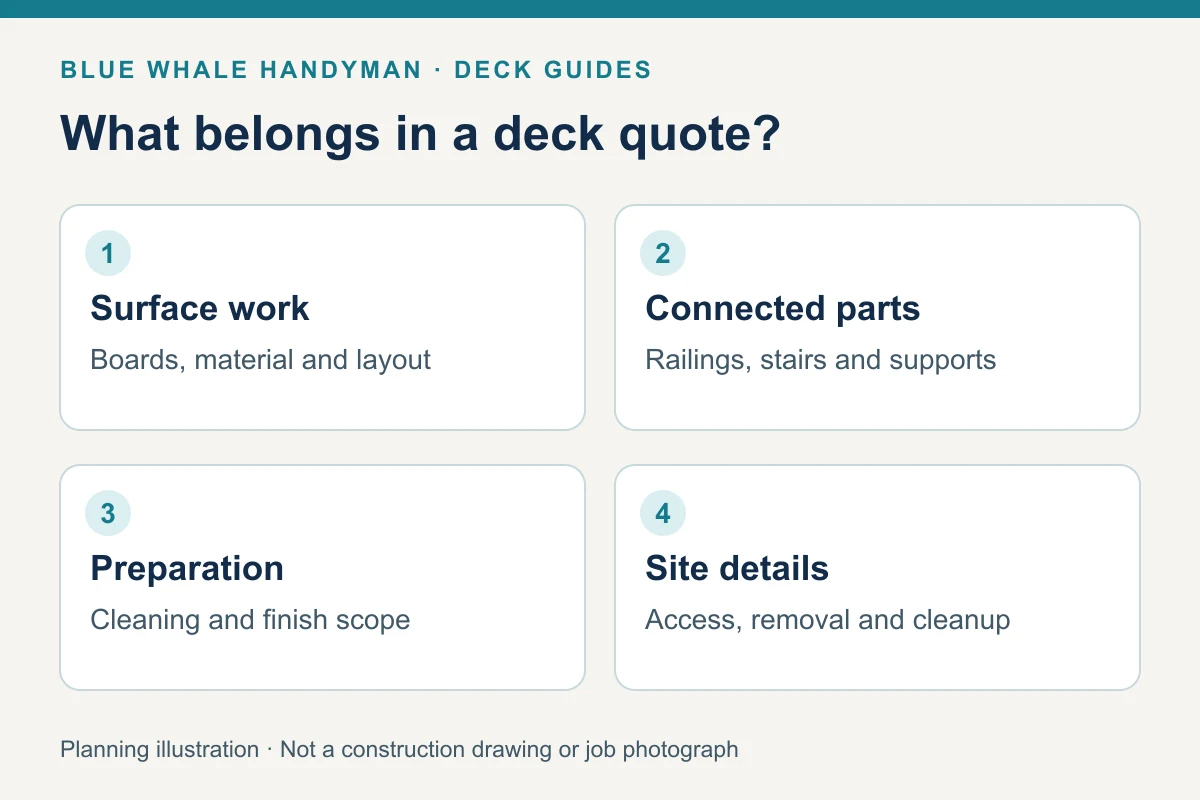
A useful deck repair estimate identifies the damaged components, the proposed work and the assumptions behind the price. A low total is hard to evaluate if it is unclear whether it includes removal, disposal, matching materials and finishing.
Begin with wide photographs, approximate dimensions and a short description of the problem. Explain whether you want a limited repair, a renewed walking surface or cleaning and refinishing. The final proposal should turn that request into an agreed scope rather than leave “deck repair” as the entire description.
Separate the components being priced
| Part of the quote | Details to clarify |
|---|---|
| Deck boards | Quantity or area, material, profile, fastening and removal |
| Framing assessment | What is accessible, what needs opening and how additional findings are handled |
| Railings | Affected sections, posts, connections and finish |
| Stairs | Treads, supporting members, landings and handrails |
| Surface preparation | Cleaning, coating removal, sanding and the proposed finish |
| Site work | Access, protection, disposal and cleanup |
Ask what happens if hidden damage is found
The top surface does not show every connection or the condition underneath. Ask what can be assessed before work and what may only become visible after boards are removed. A proposal should distinguish confirmed work from an allowance or a possible extra.
Before pricing a new walking surface over existing supports, read when deck boards can be replaced while retaining the frame.
Agree how additional work will be documented and approved. A written description and photographs of an unexpected condition are more useful than an unexplained increase in the total.
Material matching and finishing can change the scope
A few new boards may differ visibly from older ones. Ask whether the quote assumes a close match, a deliberately contrasting detail or a broader surface replacement. Product availability and board dimensions matter as well as the color.
For wood, identify whether the price includes preparation and a finish or leaves the new material unfinished. For composite, confirm the specific product and approved fastening system. “Materials included” should still name what is being supplied.
Keep cleaning and coating work explicit
Use our comparison of deck cleaning and restaining to decide which surface work you want quoted.
Ask which areas are included: walking boards, rails, stair faces and edges can be different parts of a refinishing scope. Preparation may vary between worn-through areas and patches where an old coating still adheres. The selected product instructions should determine application conditions rather than an assumed same-day schedule.
Compare written options and exclusions
The FTC’s home improvement guidance recommends comparing written estimates. For a deck, compare a defined scope and materials rather than a single price per square foot.
For a local assessment and a proposal for the work your deck needs, see our deck repair services on Long Island.
- Confirm the affected areas and the proposed materials.
- Separate required repairs from optional appearance upgrades.
- Identify site protection, disposal and cleanup.
- Record exclusions, assumptions and the process for changes.
- Ask about scheduling, payment terms and any applicable approvals.
Common questions
Is a price per square foot enough to compare deck repairs?
No. It can help describe a comparable surface area, but it does not explain railing length, stair work, hidden-condition allowances, preparation or access. Ask for those items to be defined separately.
Can photos produce a final repair price?
Photos can support an initial discussion. The final price depends on what needs to be measured and assessed in person, especially supports and connections that the photographs do not show.
Should I buy the replacement boards before requesting a quote?
Confirm the plan first. Dimensions, product compatibility, fastening, quantity and the condition of the existing structure can affect the material selection.
Can a deck repair be divided into phases?
Sometimes. Ask which work must happen together and which appearance choices can wait. Any area with a safety concern should be assessed before deciding that the rest of the deck can remain in use.