
Project Planning
Wood vs. Composite Replacement Boards for an Existing Deck
By Ivan ·
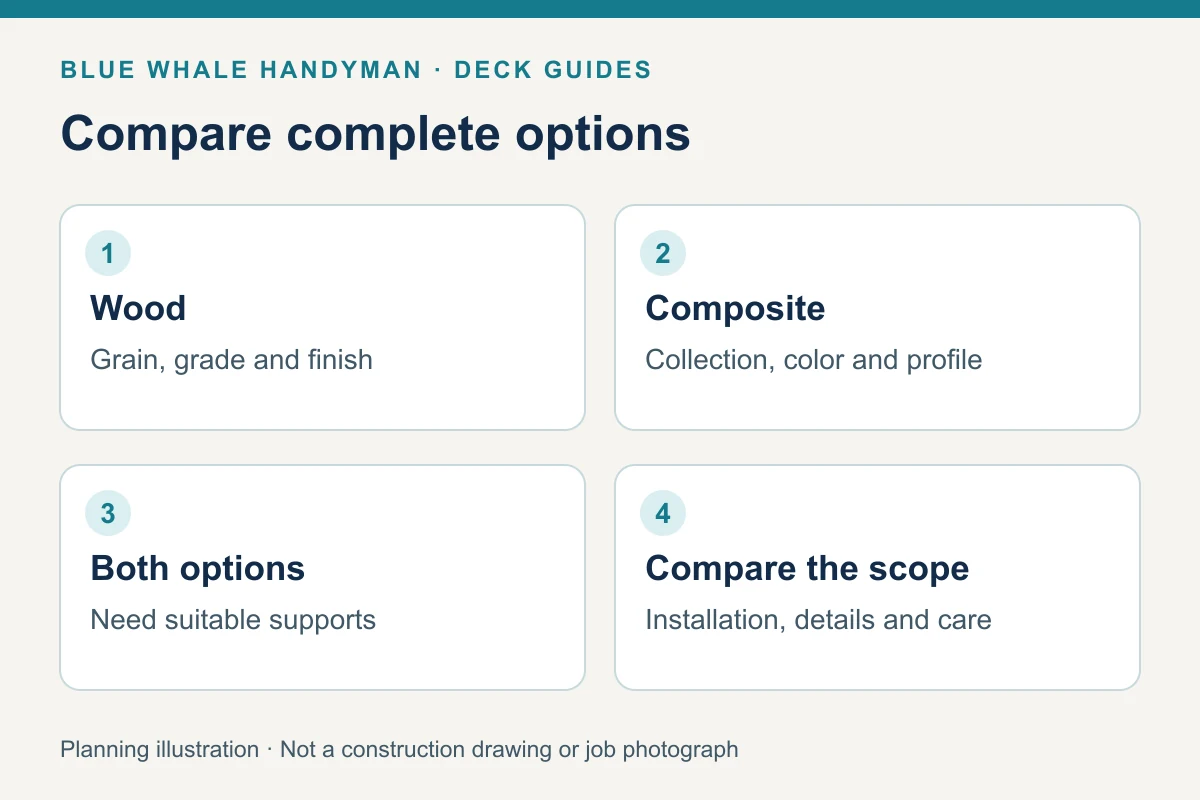
For an existing deck, the best replacement board is one that suits the assessed structure, the intended appearance and the maintenance you are willing to arrange. The material label alone cannot determine that choice.
Keep two decisions separate: whether the deck can retain its existing frame, and which replacement surface works with that plan. Once the viable options are established, compare complete proposals using the same deck area and finished details.
Confirm the retained structure first
Start with the assessment needed before replacing boards over an existing frame.
The Trex resurfacing guidance makes the existing structure and product installation requirements part of planning a replacement surface.
Ask whether each proposed material can use the assessed supports as they stand or needs modifications. Board layout, stairs, thickness and fastening can change the scope. A board price without those details is not a complete installed comparison.
Compare care rather than a maintenance-free promise
TimberTech’s product FAQs distinguish its composite care requirements from the recurring coating work associated with wood. This is manufacturer guidance for its products, not a promise about every board sold as composite.
Wood can provide a natural material and a finish that can be renewed within the limits of the selected system. Composite offers a manufactured color and surface with its own cleaning and care instructions. In either case, consider the work you will actually arrange over time.
| Decision | Wood option | Composite option |
|---|---|---|
| Appearance | Species, grade, grain and selected finish | Collection, color, profile and visible edges |
| Care | Cleaning and finish maintenance for the chosen system | Cleaning and care for that product and generation |
| Partial repair | Matching size and appearance of aged boards | Availability of the exact profile and color |
| Installation | Appropriate support and fastening plan | Manufacturer-specific support and fastening plan |
| Price comparison | Full installation and finish scope | Full installation and required detail changes |
Think about partial replacement differently from a whole surface
If only a few boards need replacement, a material change may create awkward appearance or detailing questions. Ask whether a close match is available and whether the change belongs in a larger defined area.
For a whole surface, compare sample boards and finished-edge options. Check how the proposal treats board ends, borders, stairs and transitions. Do not assume an exact match between a small new sample and an older surface that has already weathered.
Ask about the conditions where you use the deck
Tell the contractor about sun exposure, nearby vegetation, furniture and typical use. Compare actual product information rather than assuming a material is universally cool, slip-proof or resistant to every stain.
Review the current care instructions and warranty terms for the product proposed. A long warranty term does not by itself describe all exclusions, installation conditions or the services included in the contractor’s quote.
Compare complete alternatives before ordering
Use our deck estimate checklist to compare the same scope across material options.
Request product names, dimensions, fastening, any support work, included edges and stair details, disposal and finish requirements. Make the material decision against that written scope rather than a shelf price alone.
For an assessment of the existing deck and suitable repair options, visit our deck repair service page.
Common questions
Is composite always the less expensive choice over time?
That depends on the installed scope, product, care and period you are comparing. Use actual proposals and product requirements rather than an assumed universal payback period.
Can I mix wood and composite boards on the same surface?
Ask for a design and compatibility assessment. Differences in dimensions, fastening, movement and appearance need consideration; a similar-looking width does not establish that the products are interchangeable.
Can composite be stained like wood later?
Do not assume it can. Follow the guidance for the exact manufacturer and product generation. Some products have restrictions on coatings, sanding or cleaning methods.
What if the existing composite color is discontinued?
Ask what matching profiles remain available and compare a defined larger replacement area if an acceptable match cannot be obtained. Agree the appearance expectation before ordering.