
Exterior Projects
Signs Your Deck Needs Repair: What to Notice and Who to Call
By Ivan · · Updated
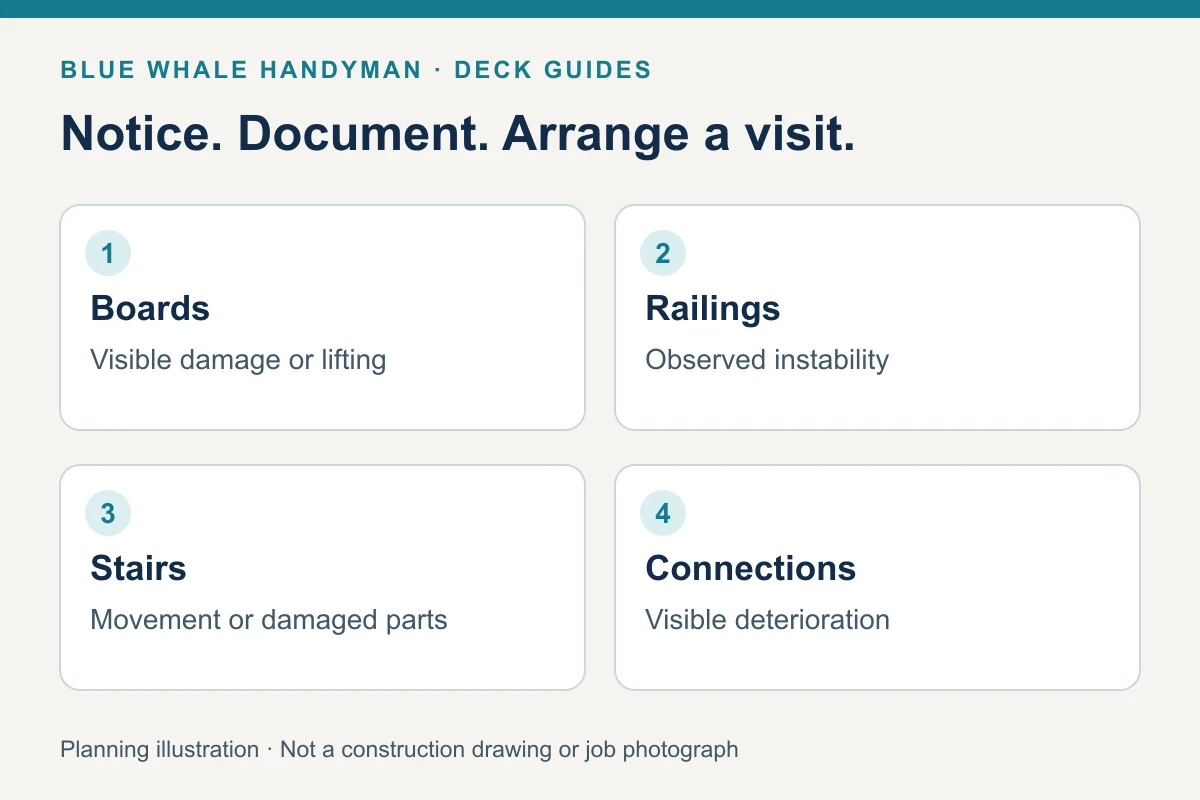
A damaged walking board, unstable railing or moving stair can be a sign that a deck needs repair, but the visible symptom does not establish the full scope. The useful first step is to describe the concern and arrange an appropriate assessment.
This guide helps you notice and document issues from a safe position. It replaces the idea of a quick do-it-yourself clearance test: neither a short inspection nor a fresh finish can certify the deck for use. If you already suspect instability, keep people away and seek professional help.
Document the concern without testing the deck
Take an overall photograph from safe ground or another secure position. Describe the affected side, stair or railing section, and include any known history of impact, storm damage or previous repairs. Do not shake a railing, jump on stairs or remove a board to demonstrate the issue.
NADRA’s consumer deck checklist identifies areas homeowners should be aware of and expressly distinguishes that awareness from a code-compliance evaluation.
Keep the visible problem and the assessment separate
| What you have noticed | What to discuss |
|---|---|
| Broken, lifting or visibly deteriorated boards | The affected surface and supporting condition |
| Unstable railing or handrail | The assembly, posts and connections |
| Stair movement or damaged step components | The entire flight, supports, attachments and landing |
| Deterioration or corrosion around connections | An assessment of the connected materials and hardware |
| Lifting coating or accumulated surface dirt | Whether finish work, cleaning or repairs are appropriate |
Boards and framing are different repair decisions
Our guide to replacing deck boards while retaining a frame explains what needs assessment before resurfacing.
There is no promise that an older deck can be repaired indefinitely, or a single visual rule that determines when it must be replaced. The recommendation should account for the retained structure, the proposed materials and the extent of the work.
Give railings and stairs their own attention
Use the questions in our loose deck railing guide when a rail, post or connection appears affected.
For a flight of steps, see deck stair repair versus replacement.
A tidy repair to one visible piece does not settle the condition of the rest of an assembly. Ask the assessor to explain what can remain, what needs work and what cannot yet be established.
Do not confuse a finish problem with a structural finding
For dirt, weathered appearance or a failing coating, compare cleaning and restaining scopes.
Finish maintenance should follow the material and selected product guidance. Water beading, a fresh color or a smooth surface alone is not a safety assessment. Confirm any repair concerns before arranging surface work.
Request a clearly described next step
Our deck repair services can help you start a discussion about the concern and the assessment needed.
When comparing proposals, use the deck repair estimate checklist.
Send photos, a short task list and known history. Ask the proposal to distinguish confirmed repairs, any specialist assessment and conditions that might change the scope after opening.
Common questions
Does a visual deck check prove that it is safe?
No. It can help identify concerns to report, but it does not establish the condition of concealed components, structural suitability or code compliance. Arrange a qualified assessment when there is a concern.
Do gray deck boards automatically need replacement?
Color alone does not establish the condition or repair scope. Ask whether the concern is surface appearance, coating condition, physical damage or something affecting the supporting assembly.
Can a small repair wait until refinishing season?
The urgency depends on the concern. An unstable railing, damaged stair or suspected structural issue should be assessed promptly rather than scheduled around cosmetic work.
Should I climb under the deck to take photos?
Do not enter an unsafe or difficult area to collect photos. Send what you can document safely and explain which areas the assessor will need to access.