
Home Repairs
Loose Deck Railings: What Should Be Assessed Before Repair?
By Ivan ·
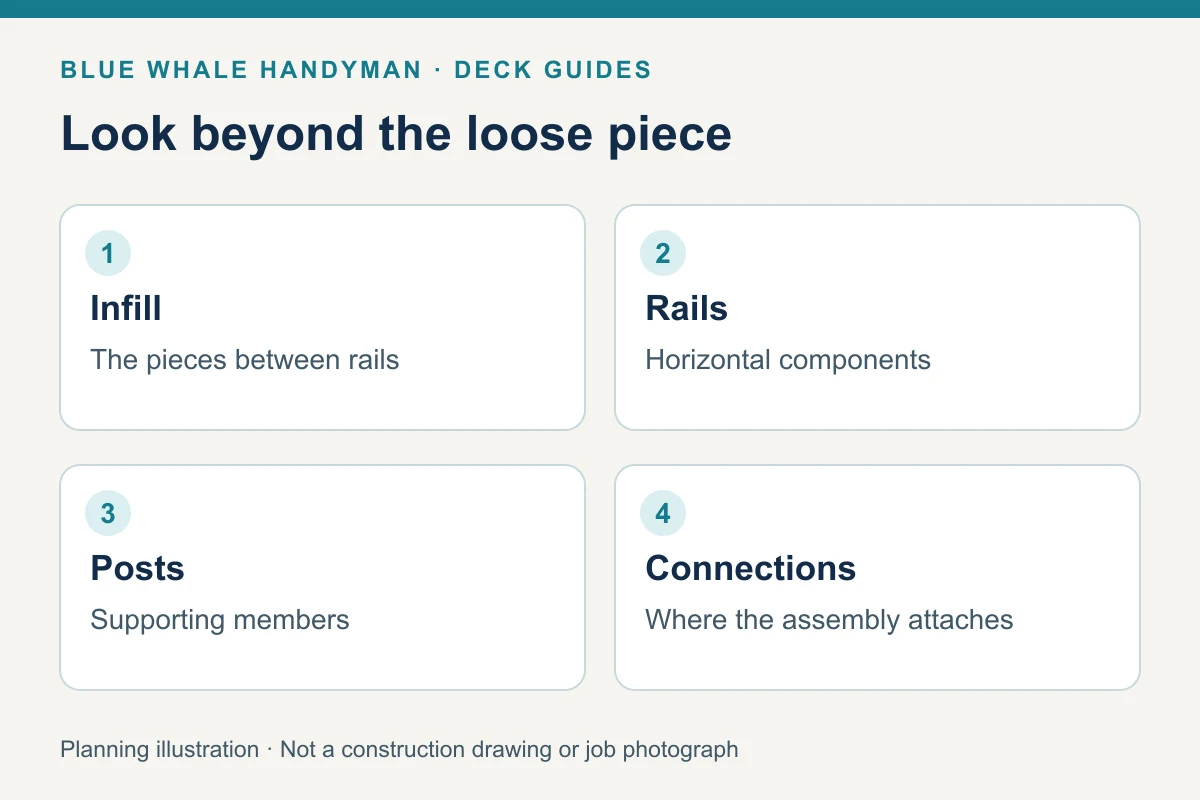
A loose deck railing can involve a small component, a deteriorated post or a connection to the underlying structure. The repair should address the actual cause, not simply make the visible piece look straight.
If a guard or handrail is unstable, do not lean on it, shake it to demonstrate the problem or let people use the affected area. Arrange an assessment and explain where movement has been noticed. Photos can be taken from a safe position without testing the railing.
Describe which part is involved
A guard helps protect an open edge. A handrail provides a graspable support along a route such as stairs. A deck can have both, and the same-looking piece does not necessarily serve the same function.
For a repair discussion, identify whether the issue appears in a single vertical infill piece, the horizontal rail, a post or the point where the assembly meets the deck. That description is a starting observation, not a diagnosis.
| Observed concern | Question for the assessor |
|---|---|
| One loose infill piece | Is the damage isolated, and are adjacent pieces and rails sound? |
| Movement along a rail | Are the rail ends, supports and connections suitable? |
| Movement at a post | What is happening at the post and its connection to the deck? |
| Deterioration around hardware | What materials or connections need replacement rather than tightening? |
| Movement by stairs | Do the stair structure, guard and handrail all need attention? |
The connection needs attention as well as the visible surface
A fresh board cannot establish the condition of the material it fastens into. Ask how the affected post or rail is supported and what needs to be opened to assess that support. The solution may involve components outside the most visible damaged spot.
NADRA’s professional deck evaluation guide treats guards, handrails and supporting components as parts of the evaluation. A homeowner’s visual check does not certify a deck as safe or compliant.
Set appearance and material expectations
Ask whether a selective repair can match the existing material, profile and finish. If the original system is discontinued, a larger section may need consideration. Replacement parts for a manufactured railing should be selected for that system rather than chosen only because they look similar.
Keep the appearance decision separate from the condition assessment. A matching finish is useful, but the proposal first needs to explain which components and connections the repair covers.
Prepare a useful repair request
Include an overall photograph from a safe location, identify the affected section and describe when you first noticed the concern. Mention any recent impact, storm damage or earlier repair that you know about. Do not remove covers or fasteners to collect evidence.
If the problem is along steps, also read what a deck stair repair assessment should cover.
For a site visit and defined scope, contact our deck railing and repair service.
- Name the affected side or section of the deck.
- Describe observed movement without recreating it.
- Explain the material and any known repair history.
- Ask what is included, what is retained and what needs further assessment.
Common questions
Can a loose railing just be tightened?
That depends on the cause and the condition of the assembly and supporting materials. Tightening a visible fastener does not resolve every post, connection or deterioration problem. Have the scope assessed before assuming that is enough.
Can I use the deck while waiting for a railing repair?
Keep people away from the affected area and ask the assessor about access. A photograph or a remote description cannot establish that the remaining deck is safe to use.
Does a pool handrail use the same repair as a deck guard?
No. A pool handrail anchor and a deck guard connection are different assemblies. Identify which one needs attention so that the proposal addresses the correct system.
Will replacing a few railing boards change the whole appearance?
It may. New wood can differ from weathered material, and manufactured systems may have limited matching parts. Ask for the available appearance options after the necessary repair is established.